
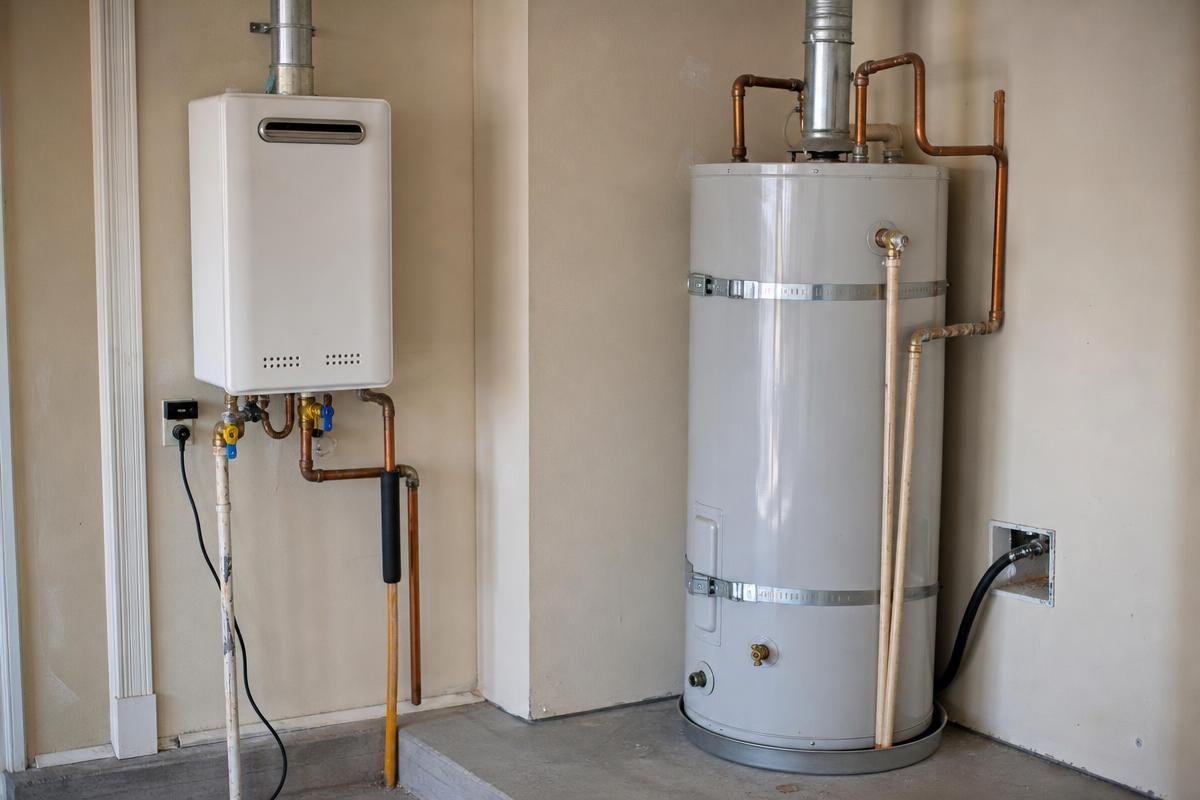
Choosing between a tankless and a tank water heater is one of the bigger decisions you’ll make for your Las Vegas home, and the wrong call can cost you hundreds of dollars over time. Las Vegas hard water, extreme summer heat, and older gas lines in established neighborhoods like Winchester and Paradise all affect which system actually performs better at your address. At Bumble Breeze Plumbing, Heating & Air, our licensed Clark County plumbers help homeowners sort through the real numbers so you can make a confident, informed choice before any work begins.
Contact a licensed Clark County plumber to discuss the right water-heater option for your home.
Key Takeaways
- Tankless water heaters cost more upfront but can lower energy bills significantly for Las Vegas households with moderate to high hot water demand.
- Las Vegas hard water accelerates scale buildup inside tankless units, making regular maintenance important.
- Older homes near Winchester and the central valley may need gas line upgrades before a tankless system can be installed.
- Tank water heaters have lower installation costs and work well for smaller households with predictable, lower hot water usage.
- Warmer incoming groundwater in Las Vegas gives tankless units a natural GPM advantage during summer months compared to colder climates.
How Does Each Type of Water Heater Actually Work?
Storage Tank Water Heaters
A storage tank water heater holds 40 to 80 gallons of water and keeps it hot around the clock. A gas burner or electric heating element runs in cycles to maintain your set temperature, whether you’re using hot water or not. That constant reheating is called standby heat loss, and it’s the main reason tank units cost more to run month after month.
In Henderson and Spring Valley homes where the water heater sits in a hot garage, summer ambient temps above 110°F actually shrink that standby loss slightly. The surrounding air is already warm, so the tank doesn’t work as hard to hold temperature. It’s a small offset, but it’s real. For most households, a 40-gallon tank works for one to two people, a 50-gallon for three to four, and a 75-gallon for five or more.
Tank units typically last 8 to 12 years. If yours is getting close to that range, check out our guide on when to get a new water heater before it fails at the worst possible time.
Tankless (On-Demand) Water Heaters
A tankless unit heats water only when you turn on a tap. Cold water flows through a heat exchanger, a gas burner or electric element fires up instantly, and the unit begins heating water immediately, though delivery time varies by the distance to the fixture. No stored tank. No standby heat loss.
The key number to understand is GPM, gallons per minute. A whole-house gas tankless unit delivers 7 to 10 GPM. An electric tankless delivers 2 to 5 GPM. That matters because running a shower, dishwasher, and washing machine at the same time can exceed what a single unit can handle. If you’re considering the switch, our post on unraveling the benefits of tankless water heaters covers the full picture. One advantage specific to the Clark County area: incoming groundwater runs warmer here in summer, around 65 to 75°F, which boosts effective GPM output compared to colder-climate installs.
Side-by-Side Comparison
Factor | Storage Tank | Tankless
|
|---|---|---|
Upfront Cost (unit + install) | Costs vary by equipment and installation requirements | Costs depend on the unit and installation requirements |
Lifespan | 8 to 12 years | 15 to 20 years |
Hot Water Supply | Limited to tank size | Unlimited (within GPM) |
Energy Factor (EF Rating) | 0.58 to 0.70 | 0.82 to 0.96 |
Space Required | Large footprint | Wall-mounted, compact |
Hard Water Sensitivity | Moderate (sediment buildup) | High (scale clogs heat exchanger) |
Est. Monthly Energy Cost (local) | Varies by household usage and utility rates | Varies by household usage and utility rates |
Hard water sensitivity is worth paying close attention to here. The Las Vegas Valley Water District reports hard-water conditions in the Las Vegas Valley. Confirm the current figure for your address with the utility. That scale buildup hits tankless heat exchangers especially hard, which directly affects which unit handles hard water conditions better in this area. We break that down fully in the hard water section below.
Upfront Cost vs. Long-Term Savings: The Real Numbers
Purchase and Installation Costs
Water-heater installation costs depend on the unit, fuel type, gas-line capacity, electrical requirements, and the work needed at your home. A licensed plumber should inspect the existing setup before providing an estimate.
How Long Does a Tankless Water Heater Take to Pay Off?
Whether a tankless water heater is the better long-term option depends on your household demand, fuel type, local water conditions, existing infrastructure, maintenance needs, and how long you plan to stay in the home. Compare the options using an estimate based on your specific installation requirements.
Call to check current service availability when your water heater fails.
Why Does Las Vegas Hard Water Change the Equation?
Your water heater choice does not happen in a vacuum. The Las Vegas Valley Water District reports hard-water conditions in the Las Vegas Valley. Confirm the current figure for your address with the utility. Calcium and magnesium minerals can build up over time, and your water heater is directly affected.
Tankless Units and Hard Water
Tankless water heaters heat water through a narrow heat exchanger. That tight passage is exactly where limescale accumulates fastest. Local hard water can reduce efficiency, contribute to failures, and shorten service life when required maintenance is skipped. Follow the manufacturer’s maintenance and warranty requirements for the specific unit. Check the blog on water heater regulations in Las Vegas that apply to installation and servicing requirements in Clark County.
Annual professional flushing with a citric acid or vinegar descaling solution is the minimum. We strongly recommend pairing any on-demand water heater in Henderson, the central valley, or the Enterprise area with a whole-house water softener or at least a dedicated scale inhibitor inline filter. Factor maintenance and equipment requirements into your decision.
Storage Tanks and Hard Water
Storage tanks handle hard water better than tankless units, but they are not immune. Sediment settles at the bottom of the tank over time, reducing efficiency and causing the rumbling or popping sounds homeowners often report. That water heater making noise is usually the first sign sediment has built up enough to cause real problems. The anode rod also depletes faster in hard water and should be inspected every 2 to 3 years rather than the standard 4 to 5.
Protecting Either Type
Whichever unit you choose, a simple protection plan goes a long way in Summerlin, North Las Vegas, or anywhere across Clark County:
- Annual professional flush and descale to clear mineral buildup before it causes damage
- Whole-house water softener for the most complete protection, especially with tankless
- Scale inhibitor inline filter as a lower-cost alternative that still reduces buildup meaningfully
If your unit is already showing signs of wear, our water heater repair service can assess the damage and tell you whether descaling or a full replacement makes more financial sense.
What GPM Flow Rate Does Your Las Vegas Home Actually Need?

GPM (gallons per minute) is the number that makes or breaks a tankless water heater upgrade. Buy a unit rated too low for your household, and you will get lukewarm water the moment a second shower turns on. It is the most common reason homeowners in Henderson, Anthem, and North Las Vegas end up disappointed after switching to on-demand.
Calculating Your Peak GPM Demand
Add up the GPM of every fixture you might run at the same time. Here are the numbers to use:
- Kitchen faucet: 1.5 to 2.0 GPM
- Bathroom faucet: 0.5 to 1.5 GPM
- Standard showerhead: 1.5 to 2.5 GPM
- Dishwasher: 1.0 to 2.5 GPM
- Washing machine: 1.5 to 3.0 GPM
A typical 3-bedroom, 2-bath home running two showers and a dishwasher at the same time hits roughly 6.5 GPM peak demand. A whole-house gas tankless unit rated 7 to 10 GPM handles that without breaking a sweat. A single electric tankless unit rated 2 to 5 GPM does not, full stop.
Here is a genuine local advantage: incoming cold water in the Clark County area runs about 65 to 75°F in summer, compared to 40 to 50°F in northern states. Your tankless unit raises water temperature fewer degrees, which effectively increases its usable GPM output during our hottest months. That is real performance you do not get in colder climates.
When One Tankless Unit Is Not Enough
Larger homes with 4 or more bedrooms and 3 or more bathrooms often exceed what a single tankless water heater can deliver. Your options include upsizing to a 12+ GPM gas unit, installing two units in parallel, or adding a buffer tank alongside the tankless unit. Each approach adds cost, so proper sizing before the job starts matters. Our team handles water heater installation with a full sizing assessment before any work begins, so you get the right unit the first time.
Not sure what GPM rating your home needs? Talk to a licensed Clark County plumber at (702) 703-1346 and we will size it correctly before recommending anything.
Which Type Is Right for Your Las Vegas Home? A Decision Checklist
Neither type is universally better. The right choice depends on your household size, how long you plan to stay, your upfront budget, and your tolerance for annual maintenance in a hard-water environment. Use this checklist to cut through the noise.
Choose Tankless If
- You plan to stay in the home 10 or more years, giving you time to recover the higher upfront cost through energy savings.
- Your household runs multiple showers, appliances, or fixtures at the same time and needs consistent high GPM output.
- You have an adequate gas line already sized for a high-BTU unit. Newer construction in Summerlin and Henderson often meets this requirement without upgrades.
- You are willing to schedule annual descaling. With local hard-water conditions, skipping maintenance can shorten the unit’s service life.
- You are replacing an aging storage tank that has already reached end of life. Read our guide on when to get a new water heater if you are unsure where yours stands.
- Utility closet space is tight and a wall-mounted unit makes more sense.
- You want integration with a smart home system. Pairing a tankless unit with a smart thermostat installation can add another layer of energy control.
Stick with a Storage Tank If
- Upfront cost is your primary deciding factor.
- You plan to sell within five years and do not want to absorb a premium upgrade that may not return full value at closing.
- Your gas line or electrical panel in an older Winchester or Enterprise home would need a costly upgrade before a tankless unit could be installed.
- Your household is one or two people with low simultaneous hot water demand.
- You want the simplest, lowest-maintenance option with no annual descaling requirement.
- The property is a rental or investment unit where keeping operating costs predictable matters more than peak efficiency.
Still not sure which direction makes sense? At Bumble Breeze Plumbing, Heating & Air, we walk through this checklist with every homeowner before recommending a unit. No pressure, just honest advice on the best fit for your home and budget.
Water Heater Decisions Across Las Vegas Neighborhoods
Your neighborhood’s construction era matters more than most people realize when choosing between tankless and tank water heaters. The age of your home’s gas lines and electrical panel can make a tankless upgrade straightforward or add several hundred dollars in infrastructure work before the unit even goes in.
Newer Construction: Green Valley, Anthem, and Enterprise
Some homes may already have sufficient gas-line capacity for a tankless unit, but a licensed plumber should verify the gas line and meter before installation.
Mid-Era Homes: The Central Valley and Nearby Areas
Homes in Winchester and surrounding central neighborhoods were largely built between the 1970s and 1990s. Smaller gas lines and aging electrical panels are common here. A tankless installation may require a gas line upgrade or panel work first, which adds real cost. Our team at 4755 W University Ave sees this regularly on service calls in this part of the valley.
Older Stock: Whitney, Boulder City, and North Las Vegas
These areas have a wide mix of construction eras. Each home needs its own assessment before you commit to tankless. A quick inspection tells you exactly what your home needs, with no guesswork.
Summer Heat and Your Water Heater
Garage temperatures above 110°F in summer slightly reduce standby heat loss for storage tanks. For tankless units, proper ventilation in unconditioned spaces matters for long-term performance. Water heating is also a top driver of high electric bills in Las Vegas, so pairing the right unit with good habits pays off. Check our summer energy saving tips for a broader look at keeping costs down.
We serve all of Clark County, including Green Valley, Whitney, Boulder City, and North Las Vegas. If you are not sure which category your home falls into, we can check your gas line sizing and panel capacity before you decide anything.
Frequently Asked Questions
How long does a tankless water heater last in Las Vegas?
Service life varies by unit, water conditions, installation quality, and maintenance. Follow the manufacturer’s maintenance requirements, including descaling where applicable.
Is a tankless water heater worth it in Las Vegas?
A tankless water heater may be a good fit when your household needs and installation requirements support it. Factor maintenance needs into your decision, then review our guide to the benefits of tankless water heaters before deciding.
How much does it cost to switch from a tank to a tankless water heater in Las Vegas?
Tankless and storage water-heater costs vary by equipment, fuel type, gas-line capacity, electrical requirements, and installation scope. If you are noticing performance issues, check out these top 7 signs your home water heater is failing before the situation gets urgent. Contact us for an estimate based on your home.
Does Las Vegas hard water damage tankless water heaters faster?
It absolutely can. Hard water in Las Vegas can contribute to mineral buildup in the heat exchanger. Follow the manufacturer’s maintenance requirements and ask a qualified plumber whether a scale-control option fits your installation.
What size tankless water heater do I need for a 3-bedroom Las Vegas home?
Most 3-bedroom homes here need a gas tankless unit rated at 7 to 9 GPM. One advantage in the Mojave climate is that ground temperatures run 65 to 75°F in summer, so incoming water is already warmer than in northern states. That means a slightly lower BTU rating can still meet your peak demand during the hot months.
How often should I flush my water heater in Las Vegas?
Once a year, minimum, for both tank and tankless units. That is more frequent than the national 1 to 3 year recommendation, but local water hardness makes it necessary. For tankless units, citric acid or white vinegar descaling does the job. For storage tanks, a drain-and-flush removes sediment that quietly cuts efficiency. Skipping this is one of the fastest ways to shorten your unit’s life and raise your energy bill. Our team handles water heater repair and maintenance if you need a hand.
Are there current incentives for installing a tankless water heater in Nevada?
Potential tax credits and utility incentives vary by program, equipment, and installation date. Check current official program requirements before making a purchase decision.
Ready to stop guessing and get the right water heater for your home? Call Bumble Breeze Plumbing, Heating & Air at (702) 703-1346 to schedule a no-pressure consultation. Our licensed team will assess your gas line, household size, and hard-water conditions, then give you a straight answer and upfront pricing before any work starts.
Ready to Get Started with Bumble Breeze Plumbing, Heating & Air?
Call (702) 703-1346 to speak with our team directly. We’re ready to answer your questions, walk you through your options, and help you find the right solution for your needs. Whether you’re just starting to plan or ready to move forward, we’ll make the process simple and stress-free.
Reach out today and let’s talk about how we can help.