
Your attic could be hitting 150°F this summer, and if your home insulation is still at the R-19 level common in homes built during the Las Vegas construction boom of the 1990s and 2000s, your cooling system simply cannot keep up. Thin or aging insulation lets heat pour in faster than any AC can push it out, driving up your energy bills month after month.
At Bumble Breeze Plumbing, Heating & Air, our Nevada-licensed technicians help homeowners across Clark County fix that with honest assessments, upfront pricing, and real solutions that make a noticeable difference on your next utility bill. Ready to stop overpaying to cool your home? Let our certified team take a look.
Key Takeaways
- Las Vegas attics can reach 150°F in summer, making adequate home insulation far more critical here than in cooler climates.
- Many local homes built in the 1990s and 2000s still have R-19 attic insulation, well below current Nevada energy code requirements.
- Upgrading insulation materials like spray foam or cellulose can meaningfully reduce your cooling costs without replacing your AC system.
- The Federal 25C tax credit lets qualifying homeowners claim 30% of insulation material costs, up to $1,200 per year.
- Duct insulation is often overlooked; pre-2010 homes frequently have under-insulated flex duct that leaks conditioned air into unconditioned attic space.
Why Your Las Vegas Home Feels Warm Even With the AC Running

Your electric bill spikes every hot-weather season, and your AC runs almost nonstop, yet the house still feels warm. The most likely reason is not a broken AC. It is a home that is leaking cooled air through a poorly insulated attic, walls, and gaps you cannot see. According to NV Energy’s residential energy use data, cooling accounts for roughly 50% of a Clark County household’s electric bill during the hottest months, and a home with inadequate insulation can push cooling costs 20 to 30% higher than a properly sealed home.
Many homes in Henderson and Green Valley were built during that era with insulation levels that fall well below current Nevada energy code. That means your AC is fighting desert heat without the backup it needs, which is one reason AC units in this region fail faster than the national average. This article covers six real fixes, from a weekend air-sealing project to professional spray foam installation, that can reduce cooling costs fast.
Why Las Vegas Homes Lose Cool Air Faster Than Homes in Other Climates

The problem usually starts above your head. The Mojave Desert pushes outdoor temperatures to 110-115°F on a typical peak day, and that heat doesn’t just sit outside. It bakes into your roof and drives attic temperatures to 150-160°F. Homes in moderate climates rarely see attic temps above 120-130°F. That 30-degree difference is enormous, and your ceiling is the only thing standing between that superheated cavity and your living room.
The Desert Heat Gain Problem
Heat radiates down through your ceiling constantly during the hottest months. Your AC isn’t just cooling the air coming in through windows and doors. It’s fighting a radiant heat source directly overhead. That extra load is why so many Spring Valley homeowners find themselves scheduling AC repairs in Las Vegas year after year, even on relatively new systems. The equipment wears out faster because it never truly catches up.
Many homes from that era were installed with R-19 fiberglass batt insulation. That was considered acceptable at the time. It is not enough now, and the Department of Energy agrees. For IECC Climate Zone 3B, which covers the entire Clark County area, the DOE recommends attic insulation rated R-38 to R-60 for existing homes.
How Insulation R-Value Works in Extreme Heat
R-value measures resistance to heat flow, and the higher the number, the slower heat moves through the material. At R-19, heat crosses your attic floor roughly twice as fast as it would at R-38, given the same temperature difference. With a 150°F attic above a 78°F thermostat setting, that gap is massive. R-19 was marginal in a mild climate. In the Mojave, it is simply not enough insulation to protect your home or your cooling costs.
Fix 1: Upgrade Your Attic Insulation to R-38 or Higher
Your attic is where you lose the battle against heat first, and if your attic insulation is sitting at R-19, which is what most legacy construction in the valley has, your AC is fighting a losing battle every single day. Those extreme attic temperatures overwhelm thin insulation quickly. The Department of Energy recommends R-38 as a minimum for our climate zone, with R-49 to R-60 being the real target for homes with high cooling loads.
The good news is that upgrading your attic insulation is one of the fastest payback improvements you can make. Many homeowners notice a difference on their first billing cycle after the upgrade. You may also find you can adjust your thermostat setpoint, which means less strain on your system overall. Pair that with regular AC maintenance and your equipment runs more efficiently for longer.
Blown-In Cellulose vs. Fiberglass Batts for Las Vegas Attics
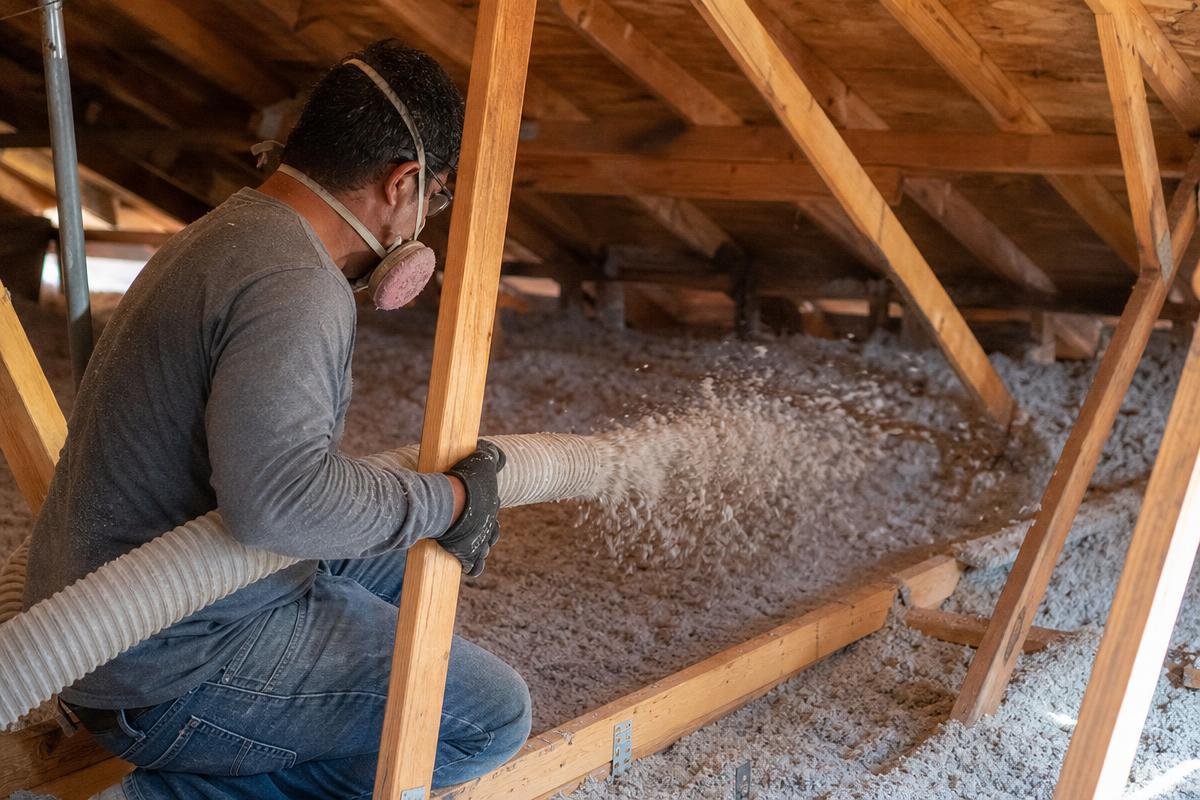
For existing attics, blown-in cellulose is usually the better call. It is made from recycled paper treated with borate for fire and pest resistance. It delivers R-3.2 to R-3.8 per inch, so a 12-inch layer gets you to roughly R-38. It also settles into irregular joist bays and around obstructions better than batts can. In our dry climate, cellulose performs consistently without moisture concerns slowing it down.
Fiberglass batts are common in homes here, but they compress over time. Compressed batts lose effective R-value, which means that R-19 on the label may actually be performing worse than rated. Batts work well in new construction or open wall cavities. For topping up an existing attic floor, blown-in material wins. Spray foam is another option for specific spots like attic decks and rim joists, but we cover that in Fix 3.
What the Upgrade Process Looks Like
First, we measure what you already have. Then we seal air gaps around recessed lights, HVAC penetrations, and any bypasses before adding a single inch of new material. Skipping that step wastes the upgrade. After sealing, we blow in additional cellulose or fiberglass to bring your attic up to the target depth.
A typical upgrade from R-19 to R-49 takes a crew about four to six hours, and installed costs commonly land between $1,800 and $3,500 for an average home. The Federal 25C tax credit lets you claim 30% of material costs, up to $1,200 per year, which cuts your net cost significantly.
Fix 2: Seal Air Leaks Before Adding Any Insulation Material
Adding new insulation on top of unsealed gaps is like putting a heavy blanket over a screen door. Insulation slows conductive heat flow, but it does almost nothing to stop hot outdoor air pushing straight through cracks and penetrations. The DOE estimates air sealing alone can cut heating and cooling costs by 10 to 20 percent. Skipping this step wastes every dollar you spend on new material.
Unsealed gaps also pull in desert dust from outside. That fine particulate works through wall penetrations and attic bypasses and circulates through your living space all day. Sealing those gaps first protects your indoor air quality just as much as it protects your energy bill.
The Most Common Air Leak Locations in Las Vegas Homes
Older tract homes in Centennial Hills and North Las Vegas are especially prone to dried, cracked caulk around window and door frames. The extreme heat cycles break down sealants faster here than in moderate climates. Check these spots first:
- Attic hatch or pull-down stair frames
- Recessed can light housings where older fixtures meet the drywall
- Top plates where interior walls meet the attic floor
- Plumbing and electrical penetrations through ceilings and walls
- The door frame between your garage and living space
- Cracked caulk around window and exterior door frames
Weatherstripping, Caulk, and Foam Sealant: Which to Use Where
Material choice matters. Use paintable silicone or latex caulk for stationary gaps around window frames and trim. Use low-expansion polyurethane foam for plumbing and electrical penetrations or any gap wider than a quarter inch. Moving parts like doors need V-strip weatherstripping or a door sweep, not caulk. For the attic hatch, cut rigid foam board to fit and attach it directly to the cover.
Always seal first. Then add insulation. That order is non-negotiable if you want real results.
Fix 3: Use Spray Foam Insulation for Walls, Rim Joists, and Hard-to-Reach Gaps

Spray foam is the only insulation material that seals air leaks and insulates at the same time. That dual job makes it the highest-performance option for specific spots in your home, especially where that heat load is relentless. If batts keep falling out of your rim joists or you have irregular cavities that nothing else fills cleanly, spray foam is the right call.
Open-Cell vs. Closed-Cell Spray Foam: What Las Vegas Homes Actually Need
Open-cell spray foam runs R-3.5 to R-3.7 per inch. It expands to fill cavities completely and costs less than its counterpart. Because it is permeable to moisture, some climates avoid it, but our dry desert air makes that concern minimal. That makes open-cell a practical, budget-friendly choice for interior wall cavities and attic decks.
Closed-cell spray foam delivers R-6.0 to R-7.0 per inch and cures into a rigid, dense layer that also acts as a vapor barrier. Use it on exterior walls, the underside of roof decking in conditioned attic conversions, and rim joists in homes with raised foundations. A hybrid approach works well for most attics: seal penetrations with closed-cell first, then blow cellulose over the attic floor for cost efficiency.
Where Spray Foam Outperforms Every Other Material
Spray foam wins in spots where batts simply cannot conform. The best applications include:
- Rim joists where batt insulation keeps slipping out
- Knee walls in two-story homes
- Around HVAC ducts passing through unconditioned attic space
- Irregular cavities and oddly shaped gaps near plumbing or wiring
One important note: spray foam requires a licensed contractor and typically a 24-hour vacate while the foam cures and off-gasses. This is not a DIY project. If you are planning a full envelope upgrade alongside a new system, our AC repair and replacement services pair well with a spray foam installation for maximum efficiency gains. Poor indoor air quality can also result from gaps that spray foam eliminates, so the benefits go beyond just lower energy costs.
Fix 4: Insulate and Seal Your HVAC Ducts to Stop Cooling Losses
You can add R-49 attic insulation and still see sky-high cooling bills. If your ducts are leaking or under-insulated, the EPA estimates that 20 to 30 percent of conditioned air never reaches the room it was meant to cool. That’s money leaving your home before it does any work.
How Leaky Ducts Undermine Your Insulation Investment
In a scorching attic, supply ducts carrying 55°F air absorb heat fast. Every loose joint or thin duct wall turns your AC system into a money pit. If you’ve noticed uneven cooling or rooms that never quite reach the thermostat setting, leaky ducts are a likely cause. That same problem often shows up on your utility statement, and it’s one of the most common HVAC-related reasons for high electric bills in Clark County homes.
A professional duct blaster or blower door test will tell you exactly how much air you’re losing before and after repairs. We use mastic sealant at all duct joints, not tape. Tape fails in extreme heat. Mastic holds.
Duct Insulation Standards for Las Vegas Attic Installations
Nevada’s IECC 2018 energy code requires a minimum of R-8 duct insulation for any duct running through an unconditioned attic space. Many homes built before 2010 in the Spring Valley and Enterprise areas still have R-4 or R-6 flex duct. That gap costs real money every single day your AC runs.
Our team can replace an under-insulated flex duct with R-8 or R-11 rated duct, or encapsulate the entire duct system during a conditioned-attic conversion. Properly sealed ducts also mean cleaner air delivery, especially when paired with professional indoor air quality services.
Want to know your current R-value? We’ll measure it for free during your insulation assessment. Call our team at (702) 674-9775 and we’ll check your ducts and attic before the next cooling season hits.
Fix 5: Add a Radiant Barrier to Reflect Desert Sun Before It Enters the Attic
Dark shingles in the desert sun can push rooftop temperatures past 170°F. That heat radiates down through your roof decking and bakes your attic before your insulation ever has a chance to slow it down. A radiant barrier stops that process at the source by reflecting infrared radiation before it is absorbed in the first place.
How a Radiant Barrier Works Differently From Insulation
Think of insulation as a thick coat. It slows heat transfer by trapping air. A radiant barrier is more like a reflective emergency blanket. It bounces radiant heat away rather than absorbing and slowing it. These two materials do different jobs, and one does not replace the other.
DOE research confirms radiant barriers reduce cooling loads by 5 to 10 percent in hot, dry climates like the one we work in every day.
That translates to real savings on your NV Energy bill every single month of peak heat season. A radiant barrier works best when your attic also has proper ventilation, so ridge vents and soffit vents are doing their job alongside it. Pair it with a whole-house fan system for attic ventilation and you get even more benefit.
Foil Sheathing vs. Radiant Barrier Paint: Which Is Worth It in Las Vegas
Foil-faced sheathing bonded to OSB or plywood is the most effective option. It reflects 95 to 97 percent of radiant heat. If you are already planning a re-roof, that is the ideal time to upgrade. For existing homes, perforated foil stapled to the underside of rafters is the retrofit approach, typically running $0.15 to $0.25 per square foot in materials.
Radiant barrier paint is a different story. Reflectivity degrades quickly as dust settles on the coating, and dry desert dust accumulates faster here than in humid markets. We do not recommend paint coatings as a primary solution. Stick with foil sheathing or perforated foil for results you can count on when temperatures spike.
Fix 6: Insulate the Garage Wall and the Door Into Your Living Space
Why the Attached Garage Is a Hidden Heat Source in Las Vegas
That room next to your garage feels hotter because it basically shares a wall with a solar oven. In July and August, garage interiors in the Clark County area routinely hit 120 to 130°F. Dark concrete floors, poor ventilation, and metal garage doors absorb heat all day and radiate it straight into your living space at night.
Older tract homes often have a shared garage wall with no insulation or only R-11 fiberglass batts. Worse, the door between the garage and house is frequently a hollow-core interior door with no weatherstripping. That gap is a direct air pathway for superheated air. If your AC seems to run constantly near that part of the house, the garage wall is likely a major reason why.
A smart thermostat can detect those temperature swings and adjust your AC schedule to compensate, but sealing the source is always the better first move.
Practical Garage Insulation Options for Existing Homes
You have three places to attack: the shared wall, the garage door, and the interior door. Here is what actually works:
- Shared wall: Add R-13 to R-21 fiberglass batts on the garage side. If drywall is already in place, blown-in cellulose insulation through small drilled holes is the least invasive option.
- Garage door: A retrofit rigid foam panel kit adds R-4 to R-8 for under $100. Full replacement with an insulated door rated R-16 or higher is the best long-term fix for reducing cooling costs.
- Interior door: Swap the hollow-core door for a solid-core or insulated steel door. Add a door sweep and weatherstripping. This single change can cut heat infiltration through that opening by 60 to 70 percent.
If your garage has an attic space above it, bring that ceiling to R-38 as well. Poor indoor air quality near the garage is another sign that air is moving freely between those two spaces.
How These 6 Fixes Work Together for Las Vegas Homes Specifically
Each fix on this list addresses a different path heat uses to enter or escape your home. Seal the air leaks, add R-value to the attic, wrap the ducts, block radiant heat, and button up the garage. Do one and you get a partial result. Do all six and the whole house starts working as a system, holding cool air longer and making your AC cycle less often.
Prioritizing the Fixes Based on Your Home’s Age and Construction
Your starting point depends on when your home was built. Here is a simple framework by era:
- Built before 2000 (central zip codes 89101-89110, older subdivisions in the valley): You likely have R-11 to R-19 attic insulation, no radiant barrier, and minimal duct wrap. Start with Fix 2 (air sealing), then Fix 1 (attic R-value), then Fix 4 (duct insulation). These three alone will deliver the biggest drop in cooling costs.
- Built 2000-2010 (Southern Highlands, Inspirada, and similar master-planned communities): You probably have R-30 attic insulation and R-6 flex duct. Top the attic up to R-49, upgrade ducts to R-8, and add the radiant barrier if you are re-roofing soon.
- Built after 2010: Your home likely meets current code minimums. Focus on Fix 2 as caulk ages and Fix 6 for the garage wall, where heat gain is often the last remaining weak point.
What to Expect After Completing All Six Upgrades
Based on DOE research on hot-dry climate retrofits, completing all six fixes can realistically cut cooling energy use by 25 to 40 percent. Rooms near the attic and garage feel more consistent. Your home holds temperature longer after the system shuts off. And an AC that is no longer fighting a superheated attic and leaky ducts will run fewer cycles and last longer. If you have had repeated breakdowns, read about what to do when your AC keeps freezing up before assuming you need a full replacement. Better insulation often solves the root cause.
Frequently Asked Questions
What is the best type of insulation for a Las Vegas home?
For attic floors, blown-in cellulose insulation or fiberglass at R-38 to R-49 is the most popular professional recommendation in the Clark County area. Pair that with a radiant barrier and you have a strong combination for existing homes. Closed-cell spray foam is the right call for exterior walls and rim joists where air sealing and moisture resistance both matter.
How much does it cost to insulate an attic in Las Vegas?
Installed costs typically run $1.50 to $3.50 per square foot. A 1,500-square-foot attic upgraded from R-19 to R-49 with blown-in cellulose commonly costs $1,800 to $3,500. The Federal 25C tax credit lets you claim 30% of insulation material costs, up to $1,200 per year, which meaningfully reduces your out-of-pocket expense. If your electric bills already feel high, our article on high electric bills and HVAC causes is worth reading alongside this.
Can I add insulation to my Las Vegas home without removing the old material?
Yes, in most cases. Blown-in cellulose and fiberglass can be added directly on top of existing attic insulation, as long as it is dry and undamaged. If the existing material is wet or moldy, it has to come out first. Always air seal before adding new material on top.
Does better insulation really lower my electric bill in Las Vegas?
Homeowners who upgrade from R-19 to R-49 and seal air leaks typically see a 15 to 25 percent reduction in cooling energy use. The biggest savings show up in June, July, and August, when an under-insulated home forces the AC to run almost without stopping. Poor insulation also stresses your equipment; see our AC repair service page if your system is already struggling.
How do I know if my home’s insulation is inadequate?
The clearest signs are rooms that stay noticeably hotter than your thermostat setting and an AC that barely shuts off on hot afternoons. Thin or patchy coverage visible in the attic is another red flag. A professional energy audit with a blower door test and thermal imaging gives you the most precise picture of where conditioned air is escaping.
Is spray foam insulation worth the extra cost in Las Vegas?
Closed-cell spray foam runs $1.00 to $1.50 per board foot installed, which is three to five times more than blown-in cellulose. That cost is justified in specific spots: rim joists, conditioned-attic conversions, and exterior wall cavities where both air sealing and high R-value per inch are needed. For open attic floors, blown-in cellulose delivers better value. Use spray foam where it earns its price, not everywhere.
Ready to stop paying for cooled air that never reaches your rooms? Bumble Breeze Plumbing, Heating & Air serves homeowners across the greater Clark County area from our office at 4755 W University Ave, Las Vegas, NV 89103. Call us at (702) 674-9775 to schedule an insulation assessment. We will tell you exactly where your home is losing conditioned air and which of these six fixes will give you the fastest return on your electric bill.
Ready to Get Started with Bumble Breeze Plumbing, Heating & Air?
Call (702) 674-9775 to schedule your insulation assessment. Our Nevada-licensed technicians will tell you exactly where your home is losing conditioned air and which fixes will give you the fastest return on your energy bill. Ready when you are.