
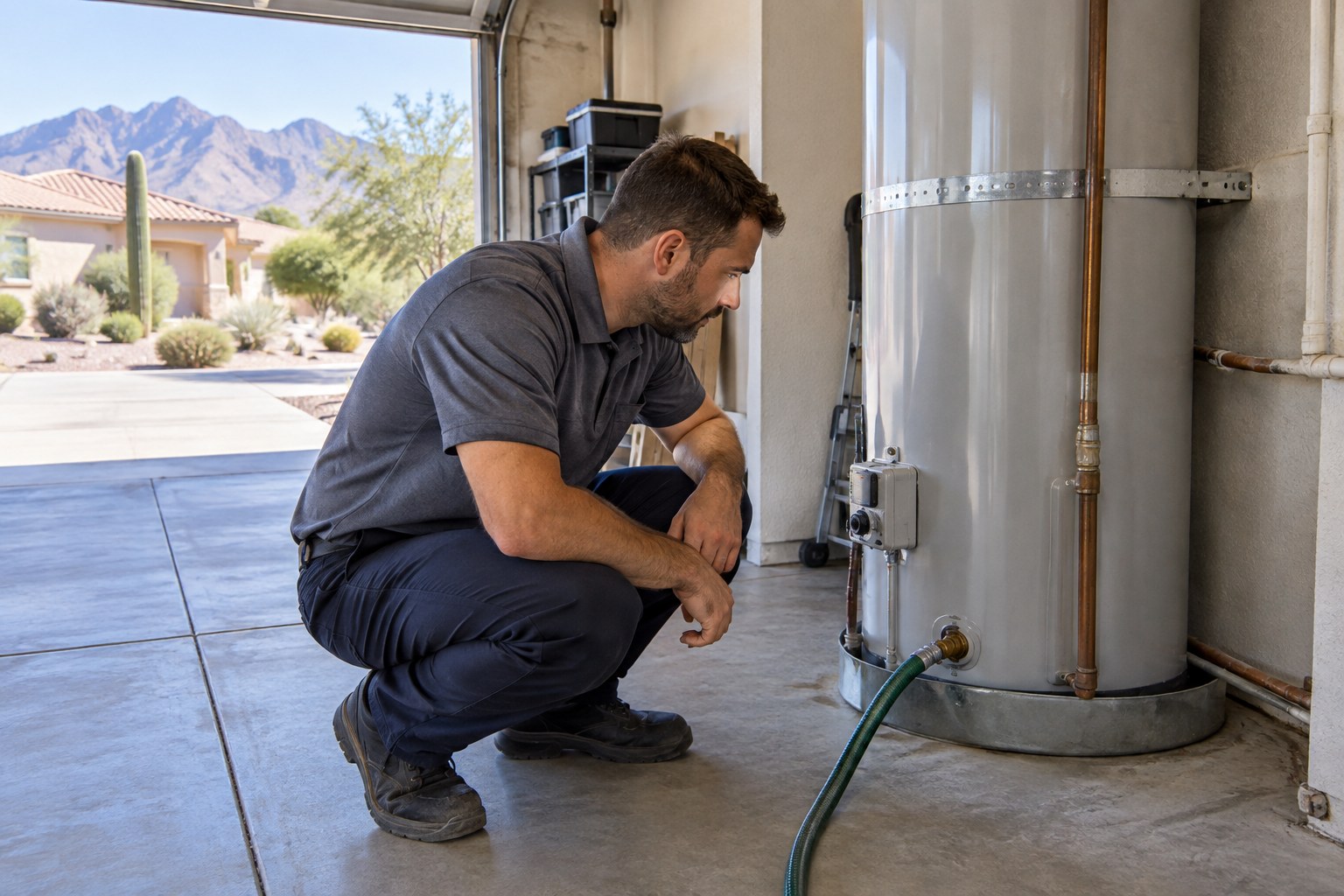
If you are asking how often to flush water heater tanks in the Las Vegas Valley, the short answer is at least once a year, and sometimes twice, because our water is unusually hard. At Bumble Breeze Plumbing, Heating & Air, our licensed technicians flush and inspect tank and tankless water heaters across the valley, and we see the same story again and again: sediment builds up fast in our hard water. Skip a flush too many times and you end up with noisy recovery cycles, less hot water, and a tank that fails years before it should.
Not sure when your tank was last serviced, or worried about the popping sound coming from your utility closet? Our team can check it out.
Key Takeaways
- Most manufacturers recommend flushing a tank water heater once a year, but Las Vegas Valley Water District’s very hard water, roughly 16 grains per gallon, often justifies flushing twice a year.
- Tankless water heaters need descaling on their own schedule, generally at least once a year and more often in very hard water, so check your manufacturer’s manual for the exact interval.
- Popping, rumbling, or crackling sounds during the heating cycle are the clearest sign that sediment has already built up on the bottom of your tank.
- A water softener slows sediment and scale formation significantly and can stretch the interval between flushes and descaling services.
- Gas water heaters need the gas control set to pilot or off before draining, and electric units need the breaker shut off first, so if you are not comfortable with that step, call a licensed technician instead.
- An old, corroded drain valve, a depleted anode rod, or a tank that has never been flushed are all situations where a professional flush is safer than a DIY attempt.
Las Vegas draws its water mostly from Lake Mead by way of the Colorado River, and that water picks up a heavy mineral load on the way. Las Vegas Valley Water District’s own water quality reporting lists total hardness around 280 parts per million, which works out to roughly 16 grains per gallon, a level classified as very hard. That mineral content does not disappear when the water leaves your tap. It settles inside your water heater, your fixtures, and your pipes.
Every time your tank heats water, dissolved calcium and magnesium drop out of solution and collect as sediment on the tank bottom. The hotter and harder the water, the faster that layer grows. Knowing how often to flush water heater tanks in this specific climate means understanding both the manufacturer’s baseline schedule and what our valley’s water actually does to that schedule.
How Often to Flush a Tank Water Heater in Las Vegas

The honest answer to how often to flush water heater tanks depends on your water hardness, your tank’s age, and how much hot water your household uses. Many tank water heater manuals recommend draining a small amount of water periodically to release loose sediment, plus a full flush at least once a year. Always follow the manual for your specific model. In average municipal water, that annual schedule works fine for most homes.
Why Las Vegas Needs a Shorter Interval
Las Vegas water is not average. At around 16 grains per gallon, our water sits well above the roughly 10.5 grains per gallon (180 milligrams per liter) threshold the U.S. Geological Survey uses to classify water as very hard. That means sediment accumulates in a Henderson or Summerlin water heater noticeably faster than it would in a home supplied by soft groundwater. We often recommend flushing every six months for households with an older tank, a family of four or more, or a water heater set above 120 degrees Fahrenheit, since higher temperatures speed up mineral precipitation.
Factors That Push the Schedule Either Way
A newer tank with a factory anode rod still intact and a family of two might comfortably stretch to an annual flush. A household running a tankless recirculation loop, a large family with heavy hot water demand, or a tank that has gone two or three years without any maintenance should move to a twice a year schedule until the sediment is under control. If you already have a water softener installed, you can typically stay closer to the annual end of that range.
| Household situation | Recommended flush interval |
|---|---|
| Newer tank, softened water, light usage | Once a year |
| Typical Las Vegas home on untreated hard water | Every 6 to 12 months |
| Older tank, heavy usage, no softener, first flush in years | Every 6 months, professional flush recommended |
If your tank has never been flushed and it is more than a couple of years old, do not assume a DIY flush is the safer first move. A heavy, compacted sediment layer can clog the drain valve partway through, and an old valve that has never been cycled may not reseal cleanly. Read more about the early signs of hard water damage before you decide whether to tackle it yourself.
Tank vs Tankless: Different Maintenance, Different Schedules
Tank and tankless water heaters both suffer from Las Vegas hard water, but the maintenance looks different for each. A tank collects loose sediment on the bottom, where it insulates the burner or lower heating element from the water above it. A tankless unit does not hold standing water the same way, but its heat exchanger has narrow internal passages where scale forms a hard, adherent layer instead of loose sediment.
Tank Water Heaters
Tank units use a drain valve near the bottom to flush sediment out with the cold water supply. This is the classic flush most homeowners picture, and it is the maintenance task most directly tied to the question of how often to flush water heater tanks. Left alone, sediment reduces usable tank capacity, insulates the heating surface so the burner or element works harder, and creates the popping and rumbling sounds many valley homeowners eventually notice.
Tankless Water Heaters and Descaling
Tankless units need descaling rather than a simple flush. Most tankless manufacturers recommend descaling at least once a year, and more often in very hard water like ours. Descaling typically uses a submersible pump to circulate a descaling solution through isolation valves and back out again. Skipping descaling in a hard water area can lead to reduced flow rates, error codes, and a shortened service life for the heat exchanger. If you are weighing tank versus tankless water heater for a new install, our guide on the benefits of tankless water heaters covers how Las Vegas water quality factors into that decision.
Wondering whether your unit needs a flush right now, or considering switching to tankless? Talk to one of our licensed technicians before the next heating cycle starts.
Signs Your Water Heater Needs a Flush Now
You do not have to guess whether sediment has built up past a comfortable level. Several signs show up well before a tank actually fails, and catching them early is far cheaper than replacing a corroded tank.
Popping, Rumbling, or Crackling Sounds
A layer of sediment traps small pockets of water underneath it. As the burner or heating element fires, that trapped water boils and forces steam bubbles up through the sediment, creating the popping, rumbling, or crackling sounds many homeowners describe as their water heater “talking” to them. This is one of the most reliable signs of sediment buildup, and it tends to get louder over months as the layer thickens.
Less Hot Water, Longer Recovery Times
Sediment takes up physical space at the bottom of the tank, which reduces how much water is actually available to heat. It also insulates the heating surface, slowing how quickly the unit recovers between uses. If your hot water runs out faster than it used to, or takes noticeably longer to reheat, sediment is a common cause worth ruling out.
Rusty, Cloudy, or Gritty Water
Discolored or gritty hot water can point to sediment breaking loose and moving through your fixtures, or in some cases to a tank that has started corroding internally. Either situation deserves attention. Our post on the top signs your water heater is failing walks through how to tell the difference between a maintenance issue and a tank nearing the end of its life.
Rising NV Energy or Southwest Gas Bills
A water heater working harder to overcome an insulating sediment layer uses more energy to deliver the same amount of hot water. If your NV Energy or Southwest Gas usage has climbed without a clear reason, an overdue flush is worth checking before you assume the unit itself is failing.
How a Professional Water Heater Flush Works, and What to Handle Yourself
A basic flush follows a similar sequence for most tank water heaters, though your exact steps should always match the manufacturer’s manual for your specific model.
Before You Start: Shut Off Power and Fuel
For a gas water heater, turn the gas control valve to pilot or off before doing anything else. For an electric unit, switch off the dedicated circuit breaker at your panel. Skipping this step is a real safety risk, and it is one of the main reasons we recommend a professional flush if you are not fully comfortable working around your unit’s gas or electrical connections.
Scald Risk and Cooling Time
Water inside a working tank can sit well above 120 degrees Fahrenheit, and the U.S. Consumer Product Safety Commission notes that even water at 120 degrees can cause a serious burn in about five minutes of contact. Water drained straight from an active tank can be hot enough to scald skin within seconds. Let the tank cool, or run the hot water at a nearby fixture briefly to bring the temperature down, before connecting a hose to the drain valve.
The Flush Sequence
Turn off the cold water supply valve at the top of the tank, connect a garden hose to the drain valve, and run the other end to a safe drainage point. Open the drain valve and let water flow until it runs clear, then close the valve, remove the hose, and restore the cold water supply before restoring power or relighting the pilot according to the manufacturer’s instructions.
When to Call a Professional Instead
Call a licensed technician rather than attempting the job yourself if any of these apply: the drain valve looks corroded, calcified, or has never been opened before; you cannot get water to run clear after a reasonable amount of draining; your water heater is more than eight to ten years old and has never been flushed; or you are not confident shutting off gas or electrical power safely. Our team handles water heater repair throughout the valley, and can flush, inspect, or repair a unit that has gone too long without attention. Read more about easy ways to improve your water heater for additional maintenance habits worth building into your routine.
Anode Rods, Water Softeners, and Longer-Term Protection

Flushing addresses sediment that has already formed. Two other maintenance items address the causes behind it, and both matter more in a hard water market like Las Vegas.
Check Your Anode Rod on a Schedule
The anode rod is a sacrificial metal rod that corrodes in place of your tank’s steel lining. Many plumbers recommend inspecting the anode rod every one to two years, and replacement timing varies with your water and the type of rod. In harder water like ours, that rod can wear down faster, so more frequent inspection is worth building into your maintenance routine alongside your flush schedule. A depleted anode rod is one of the most common, and most preventable, reasons a tank corrodes and fails years ahead of schedule.
Consider a Water Softener
A whole-home water softener removes the calcium and magnesium responsible for scale before it ever reaches your water heater, your fixtures, or your pipes. Homes with a softener typically see slower sediment buildup, less scale on tankless heat exchangers, and longer intervals between flushes. If you are unsure whether your household would benefit, our post on the role of water softeners in your home’s water quality breaks down what a softener actually changes day to day.
Old, Corroded Drain Valves
Plastic drain valves in particular are prone to clogging with sediment and cracking when finally opened after years of neglect. If your valve has never been touched, or if it looks corroded, do not force it. Our licensed plumbers can replace a stuck valve safely as part of a professional flush, without risking a flood in your utility closet or garage.
If your tank is overdue and you are unsure where to start, our team can evaluate it and recommend the right interval for your household.
Frequently Asked Questions
How often to flush water heater tanks if I have a water softener?
With a properly sized softener treating your incoming water, an annual flush is generally enough, since softened water forms far less sediment than the roughly 16 grains per gallon hardness typical across the Las Vegas Valley. Without a softener, plan on flushing every six to twelve months instead, depending on your tank’s age and household usage.
Can I flush my own water heater, or should I call a plumber?
You can flush a newer tank with a working drain valve yourself if you are comfortable shutting off gas or electrical power first and handling hot water safely. If the valve is old, corroded, or has never been opened, or the tank has gone years without maintenance, a professional flush is the safer choice.
What happens if I never flush my water heater?
Sediment keeps accumulating, insulating the heating surface, reducing usable capacity, and forcing the unit to work harder for less hot water. Over time this leads to popping and rumbling noises, higher energy bills, and often premature tank failure well before the unit’s expected lifespan.
Do tankless water heaters need flushing too?
Tankless units need descaling rather than a sediment flush, since they do not hold standing water the way a tank does. In Las Vegas hard water, many manufacturers recommend descaling at least once a year, or more often depending on usage and whether a softener is installed.
Is Las Vegas water really that hard?
Yes. Las Vegas Valley Water District’s own water quality reporting lists hardness around 280 parts per million, roughly 16 grains per gallon, which falls into the very hard classification. That is a meaningful factor in how often to flush water heater tanks and descale tankless units across the valley.
What if my water heater smells like gas during a flush?
Stop immediately, leave the area, and avoid using any light switches or open flames. From a safe location, call 911 and Southwest Gas at 877-860-6020, whether you are a customer or not. Do not attempt to relight a pilot or continue any maintenance until the gas company or a licensed technician confirms it is safe.
Knowing how often to flush water heater tanks in the Las Vegas Valley comes down to one fact: our water is very hard, and it is harder on your tank than the manufacturer’s default schedule assumes. Whether you land on an annual flush or a twice a year schedule, staying ahead of sediment protects your hot water supply and your equipment. If you are overdue, or just want a professional opinion, call Bumble Breeze Plumbing, Heating & Air at (702) 703-1346. We serve Las Vegas, Henderson, Summerlin, Spring Valley, Enterprise, Green Valley, Anthem, and Whitney from our office at 4755 W University Ave, Las Vegas, NV 89103.
Ready to Get Started with Bumble Breeze Plumbing, Heating & Air?
Call (702) 703-1346 to talk with our team about your water heater’s flush schedule, a tankless descaling, or a water softener that could slow sediment buildup for good. We’re not happy until you’re happy.